
Increasing the Size of Displays with Stackable ‘Holobricks’

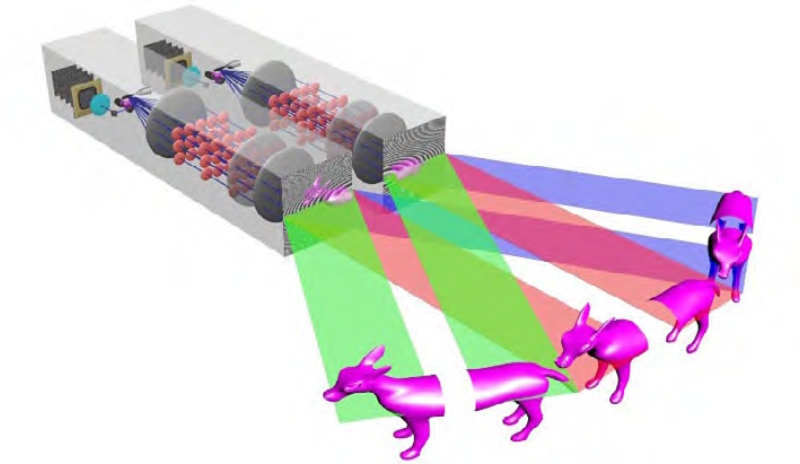
Researchers have developed a new method to display holographic images using ‘holobricks’ that can be stacked together to generate large-scale holograms.
The researchers, from the University of Cambridge and Disney Research, have developed a holobrick proof-of-concept, which can tile holograms together to form a large seamless 3D image.
This is the first time this technology has been demonstrated and opens the door for scalable holographic 3D displays. The results are reported in a paper titled ‘Holobricks: modular coarse integral holographic displays’ in the journal Light: Science & Applications 1.
The quest for large, animated 3D displays has always been hampered by the need to create a large amount of data flow. To generate a simultaneous large-size and wide-viewing-angle holographic display, a spatial light modulator (SLM) must present a holographic fringe pattern of sufficient space-bandwidth product (SBWP) – the product of fringe pitch and modulation area.
Subscriber content
Read the full article
Full access to Holography & Optical Technology News articles, newsletters and archives.